| To paraphrase someone who even when
half-asleep wrote much better that I ever will, it was the loftiest of times, the craziest
of times for the italian peninsula which is immersed in the Mediterranean and borders
along the top with France, Switzerland and Austria, so you can think of it as entirely
surrounded by sharks. I'd like to explain what kind of turmoil occurred there from 1821 to
1859 but, when I tell you the region saw in quick succession, 5 Kings of Piemonte, 5 Popes
and 6 Kings of Naples, I dont have to. Then we have small fry like the Dukes of Tuscany, Parma and Ferrara, who left home not knowing if they would return to find a fire in the house or the house on fire. Entire cities like Milan, Bologna, Naples, Modena, Parma, Ferrara, Palermo and Venice would rise, declare for independency, withstand a bloody repression, and change their minds only to start all over again a couple of years later. Treaties didnt last long enough for the ink to dry. The Pope would ally itself with Austria, and immediately join the French, Naples and Piemonte against Austria. Then, the French would occupy Genoa, which belonged to Piemonte, and Austria would occupy Bologna which was the Popes, only to return it a week later. A time for shrinks to make a fortune because it wasnt a matter of brother against brother, but someone against his alter-ego. To make some sense of the mess that was the "unification" of Italy, youd have to be an Italian. And even then.... If you do, please write me: Ive been at it since third grade, and still havent. Believe me, quantum physics is far easier. In this climate two cousins found themselves sometimes allies, often enemies. Ideologically, I mean because their families--which in 1801 had been aggregated to the Patritiate of San Marino and, in 1822 to the Nobility of Bologna--lived together. Born a few years from each other, they had grown up, and studied at--where else--Bologna.
|
|
![]() |
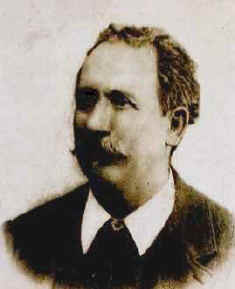
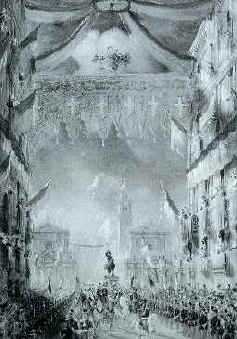
One had remained to become a nominal attorney and full-time politician. In 1844 he avoided capture by the Austrians to face the execution squad by the closest of margins--if he hadnt you wouldnt be reading this--and in 1859, when the Emilia plebiscite voted for annexation to the Kingdom of Piemonte, was among the delegates who traveled to Turin. It was a big occasion and the delegation, presided by a distant relative, Luigi Carlo Farini, was received with great fanfare, as seen by the paining commemorating the event. |
| Of the other, all I need to say is that he became General Commander of the Papal Army and Im sure youll understand what his career must have been like. This means one risked his life to end the Papal States and make of Rome the Capital of Italy, while the second had sworn to defend it to his last breath, something that must have made conversations at family dinners quite interesting. If you think this is crazy, hear this: during WWII we had one brother in the Italian Navy, Italo, and two in the US Army, Marco Antonio and Umberto (who, by the way, had been named after the King of Italys son) while their father, Zefiro, was interned for security reasons by the Allies. Rome being occupied by the Austrians one day, the French on the next, Garibaldi the third and Mazzini the fourth, it had become the most turbulent and dangerous city in Italy. So the families moved to Bologna which after the annexation had become a relatively quiet place, living--huddling would be more appropriate--together. |
|
| I guess this is why there were so many Popes in such a short time: every few minutes the Pope had to run for shelter at the fortress of Gaeta--seen here in a not-quite-peaceful picture of the era-- quicker than someone who forgot to take his Imodium.
|
![]() |
| In any case, to get back to our
story, both had a son exactly a decade apart, both sons were born at Bologna and,
following the pattern of family names, both were named "Luigi." Of the two Ill start with the one born in 1854 who, as a youngster, didnt see much of his father until after his sixteenth birthday because Girolamo was busy either defending the Pope at Gaeta or beating the Italians, which he did at Villa Cairoli, and again at Mentana in March of 1867. As a young lad, Girolamo's son remained in care of the family with his mother, Barbara Nump von Muhlem, a German baroness who, I'm sure, took all this turmoil in stride as Zappi women do. When his time came, having seen enough of Bologna, Luigi studied at Pisa, where he obtained a Doctorate in Law. Then, with the excuse of further studies in agriculture and land management, he exchanged his Gucci loafers for a pair of hiking boots, traveling extensively in Germany. On his return, Luigi distinguished himself as Imolas Mayor and, in 1890, the citizens of Bologna elected him to the Italian Parliament, where he would remain for twenty years until, in 1910, was appointed Lifetime Senator by the King of Italy. The King must have thought that was the only way some other poor fellow would have a shot at the seat but, from that point onwards, he was known as "Luigi the Senator." At the turn of the century the special commission organized to examine, regulate, and unify, the myriad of titles and patents of nobility then existing in Italy thanks to the innumerable kingdoms created thorough its history, not to mention those granted by "foreign" Kings who, at one point or another, had ruled some portion of the territory, was ready to validate claims. When our turn arrived, the family had split in two branches: ours, and the one that differentiated itself by assuming the patronymic of Zappi Recordati. Their preferences, as far as names, went to Ferrante, Antonio, and Flaminio together with the omnipresent Giovanni and Luigi. The matter of succession was quite confused and if they found it confused at their time with all the records available and the memories still fresh, Im not going to start arguing it now. In any case, the Zappi Recordati, were no slouches either and had distinguished themselves on their own merits. To give you an idea, the large sitting room decorated with frescoes and antique paintings, which today serves as office of the Vice-President of Italys Confederation of Landowners (Confagricoltura), located in Romes beautiful Palazzo Della Valle, which was built in 1510 by Sansovino, is officially named Sala Zappi after the founder of their branch. The problem was solved by splitting the titles. With Royal Decree dated May 16 1901, we were named Zappi Ceroni to differentiate ourselves from the other branch and were recognized as Marquis of Imola for our natural and legitimate descendants of both sexes, Patrician of Imola and Patrician of San Marino for males only. The Zappi Recordati passed muster a few months later, on July 10 1901, with the titles of Count, legitimate and natural males only, Patrician of Imola and Patrician of San Marino, males only. The Roman Patritiate having been dissolved (mainly because the new King didnt want anyone around who thought himself of higher status than he was), it was object of no discussions. The Zappi Recordati have once again changed their patronymic and their present representative is Count Antonio Zappi Bolcato Recordati who resides in Imola. A couple of more marriages with the sole heiress of a dying dynasty, and the Recordati portion of their surname will become a good fifth in the list of surnames--if not dropped altogether. As an aside, let me tell you right away something Ill explain in detail in the "Who is a Zappi" section: this doesnt mean every Zappi born to the family is a Marquis or whatnot. The first-born-male is one and gives it to all his sons and daughters, but only his first-born-male (if he is "natural" meaning non adopted, and "legitimate" that is, born in wedlock) can transmit it and so on. The others, male and female, have the right to use the title during their lifetimes, but their sons and daughters can't because they can't transmit it. Simple. By 1925 Luigis only daughter, Faustina, had married the Marquis De Renzis and his closest living relative was his namesake Luigi who had, in the meantime, married Teresa Minghetti, niece of Marco Minghetti, famous Bolognese statesman who had been Prime Minister of unified Italy in 1863 and again in 1873. A beautiful square smack in the center of Bologna and several schools, streets, and libraries thorough Italy are named after Marco Minghetti. The Senator made certain there would be no further succession disputes within his family by pushing through Parliament what was called the "Statute Governing Succession of Nobiliary Titles and Atributes," signed by Vittorio Emmanuele III in 1926, where the question was definitely settled. Before I take leave of Luigi the Senator, let me say that another street was named in Imola after him. So now theres a both Viale Zappi and a Via Zappi in Imola which, Im sure, is likely to generate some confusion among visitors. Certainly, they hope no other famous Zappi crops up, or they are bound to have serious problems. |
|
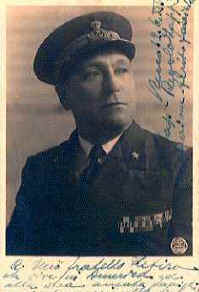
| The other Luigi, Teresa Minghettis husband (seen right), had been raised in an environment where, when the name was called during a family meeting, several heads turned and the dog came running. He decided to be more original and the couples children bore classical names. The eldest, named Mentore Giovanni after Ulysses' tutor in the Odyssey, died of pneumonia while studying medicine. The second, a daughter, was named Aurora. The third, Regulo, studied law at the usual University of Bologna but then entered the Italian Navy where he would earn the 'Medaglia d' Oro,' Italy's equivalent of the Congressional Medal of Honor. We see him below as a young Captain and Fleet Admiral.
|
|
| The writing says 'A mio fratello Zefiro che
vive in America ed alla sua amata famiglia.' That is, 'To my brother Zefiro who lives in
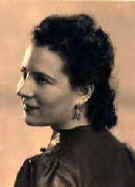
America and his beloved family.' To the left, Regulo's only daughter, Clementina, affectionately called 'Mentina.' |
|
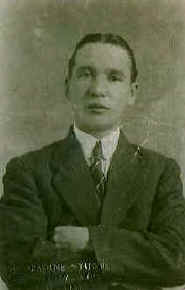
| Luigi's fourth son, born in Bologna in 1883, was given the name of Zefiro, to signify the new wind that had blown through Italy and, was hoped, would bring a better future. In addition, he received the usual plethora of family names. | |
| Zefiro Pietro Emilio studied
engineering at the usual hangout for Zappi students, the University of Bologna. The kind
of man that couldn't be confined, he first worked on the construction of the Panama Canal,
then went to Puerto Rico where he built its first urban development that would become the
City of Ponce and was appointed Italian Consul. He could have settled, but the moment he
heard there was oil in Venezuela, he moved there to exploit its oilfields. Finally, a
telegram from an old friend he had met while building the Panama Canal, the newly
appointed President of Panama, Florencio Harmodio Arosemena, that said 'Come over here, I
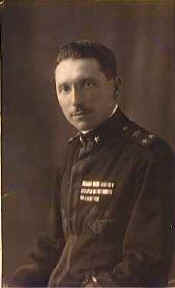
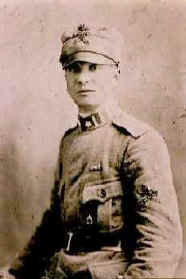
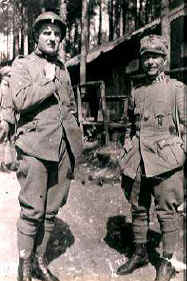
have many projects and need your help,' got him on the move again. Rabid Italian, in occasion of what in Italy is still called "The Great War" despite having fought a bigger one later (known to the world as WWI) Granpa (for me; for you, I dont know) Zefiro packed wife, children, his favorite rubber duck, and took a steamer to Italy where, accommodated everyone in Bologna, stowed a clean set of underwear along with some warm socks in a bag, put on his uniform, and left for the front to return at wars end. We see him below at the Austrian front as an officer in the Italian Army Corps of Engineers. |
|
|
|
| This rabidness didn't last long,
because after Mussolini--who was born and raised close to Imola--took power, Zefiro
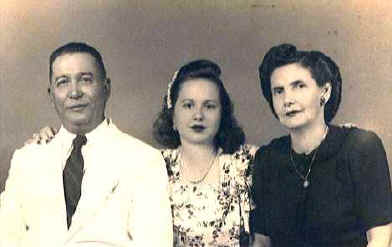
refused to return to Italy. After Pearl Harbor, when the US entered the war, Zefiro was rounded up with other Italian, German and Japanes citizens and taken to Ft. Amador in the Canal Zone. His anti-fascist views were well known however and that, added to the fact he had two sons enlisted in the US Army and one in the Italian Navy which meant he was absolutely neutral on this one, secured a quick release. From the US authorities, that is. Because Panama was then ruled by a character known as Arnulfo Arias who saw an opportunity to fatten his bank account. When I tell you Arnulfo forced the resignation of Panama's first coloured man to be elected to Parliament because he wouldn't "have a black man sitting in HIS legislature," you know the type. Zefiro languished behind bars until his wife Margarita disposed of enough property at rock-bottom prices to ransom him. Zefiro had lost a substantial portion of his fortune, but was a free man. Arnulfo had dictatorial ambitions, but got his comeuppance when Zefiro's son, Italo, returned from Italy after the war: together with Norberto Navarro and others, he led the assault to the Presidential Palace shooting Arnulfo in his nether parts. Arnulfo went into exile leaving a testicle behind. About Zefiro's sons, with the exception of Umberto who, as I already said was named after the King's own son, all bore names echoing Roman times. Therefore we have Romolo and Remo, Marco Aurelio, and Italo. Anna Teresa got lucky in that Granpa became more sensible, bestowing on her his own mother's and grandmothers names, otherwise Aunt Anna could have wound up with something like Dalmatica, Agrippina, or Livia Drusa if not Ceres. I believe his mind started on this track after the twins were born because his first son, Raoul, escaped it. Of all the names, Marco Antonio was the cleverest: it managed to echo both Rome and Marco Minghetti's at once. Finally, after Luigi the Senators death in 1932 without male issue, pursuant to Article 2 of the cited "Statuto," Regulo had inherited the title. But Regulo had no male issue either, so at war's end Zefiro found himself "Marquis" of a country that had abolished the Monarchy. By 1946, when the picture below with his wife Margarita and daughter Ana was taken (all his sons were in College resuming studies interrupted by the conflict), he was already 62 and, living in a place where such pretentions were quaint if not ridiculous, kept it quiet on one side of the ocean. I know the full regalia was commonly used in Italy--keeping in tune with Italian traditions where a "business card" is likely to be a scroll. |
|
| In America which--after all--is a
good old Italian name, Zappi alone was good enough for him and, Im sure, good enough
for all of us. But, one never knows.... |
|
|
|